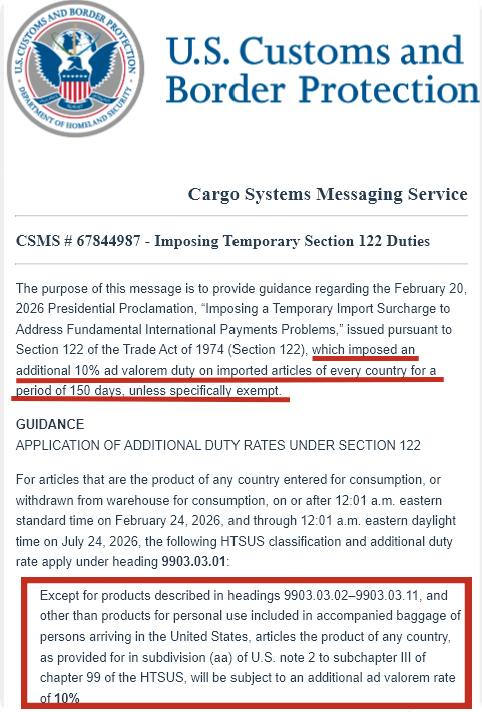
The U.S. Customs and Border Protection (CBP) issued a Cargo Systems Messaging Service (CSMS #67844987) notice at 7:00 PM local time on February 23, confirming the imposition of a 10% temporary supplemental duty on imports under Section 122 of the Trade Act of 1974. The measure takes effect from 12:01 AM (EST) on February 24, 2026.
This measure applies to imported goods from all countries and is effective for 150 days, from February 24, 2026, to July 24, 2026, unless explicitly exempted.
Separately, according to CCTV News, U.S. media reported on the 23rd local time that the U.S. government is considering imposing a new round of tariffs on approximately six industries, citing "national security" grounds.
Looking back to February 20, the U.S. Supreme Court ruled that the tariff measures previously imposed by the Trump administration under the International Emergency Economic Powers Act (IEEPA) were unlawful, determining they exceeded statutory authority.
This ruling directly impacted the following tariffs previously levied on Chinese goods:
l The 10% "Reciprocal Tariff"
l The 10% "Fentanyl Tariff"
Both of the above tariffs, implemented under IEEPA, became void following the ruling.
Subsequently, President Trump swiftly signed a new executive order, shifting the basis to Section 122 of the Trade Act of 1974 to impose a "Global Temporary Import Surtax" of 10% for a period of 150 days.
Result of Rate Change: Overall Reduction of 10%
Analyzing the change in the tariff structure:
l -10% (Cancellation of Reciprocal Tariff)
l -10% (Cancellation of Fentanyl Tariff)
l +10% (Section 122 Tariff)
Theoretically, following this adjustment, the overall tariff rate on Chinese goods exported to the U.S. has decreased by 10 percentage points compared to the previous level.
It is important to note:
l Section 301 and Section 232 tariffs remain in place;
l This adjustment only involves the tariff portions imposed under the IEEPA framework;
l If new Section 232 investigations are subsequently pursued to impose sectoral tariffs, the statutory process must still be followed, typically taking six months to a year, or approximately 1–3 months in an expedited scenario.
Key Features of Section 122
I. Rate Cap and Scope of Application
l A maximum tariff of 15% can be imposed, but the current actual implementation is 10%;
l Applies to imported goods globally;
l Effective for 150 days;
l Classified as a temporary trade restriction measure.
II. No Overlap with Section 232
l CBP has clarified:
l Goods already subject to Section 232 tariffs are not subject to Section 122 tariffs;
l However, non-metallic parts within aluminum, steel, and copper products may still be subject to Section 122 tariffs.
Eligible Exemptions or Special Handling Situations
According to the announcement and related appendices, the following situations are eligible for exemptions or special rules:
1. On-the-water exemption (goods in transit)
2. Specific tariff items listed in Appendix I, Note 2(ii)
3. Personal effects contained in accompanied baggage
4. Goods qualifying under Agreement on Civil Aircraft (GN6) tariff numbers
5. Goods qualifying under the USMCA (United States-Mexico-Canada Agreement)
6. Textile and apparel products qualifying under DR-CAFTA (Dominican Republic-Central America-United States Free Trade Agreement)
7. Humanitarian donations
8. Informational materials
9. Goods eligible for relief under Chapter 98
Drawback Eligibility
Drawback is permitted for Section 122 duties:
Meaning, after the importer pays the duty, if the goods are:
l Exported;
l Or exported after further processing;
They can legally apply for a refund of the paid Section 122 supplemental duty.
Subsequent Trajectory Remains Uncertain
Section 122 is a 150-day temporary measure. Before July 24, the policy direction remains highly variable, including possibilities of:
l Increasing the rate to 15%
l Converting it into a long-term measure
l Initiating more Section 232 industry investigations
l New trade legislation or judicial changes emerging
Overall, following this round of policy adjustments, the overall U.S. tariff rate on China has decreased by 10 percentage points compared to the previous phase. However, trade policy remains in a highly dynamic state, and businesses must continue to closely monitor subsequent executive orders and updates to CBP implementation guidelines.